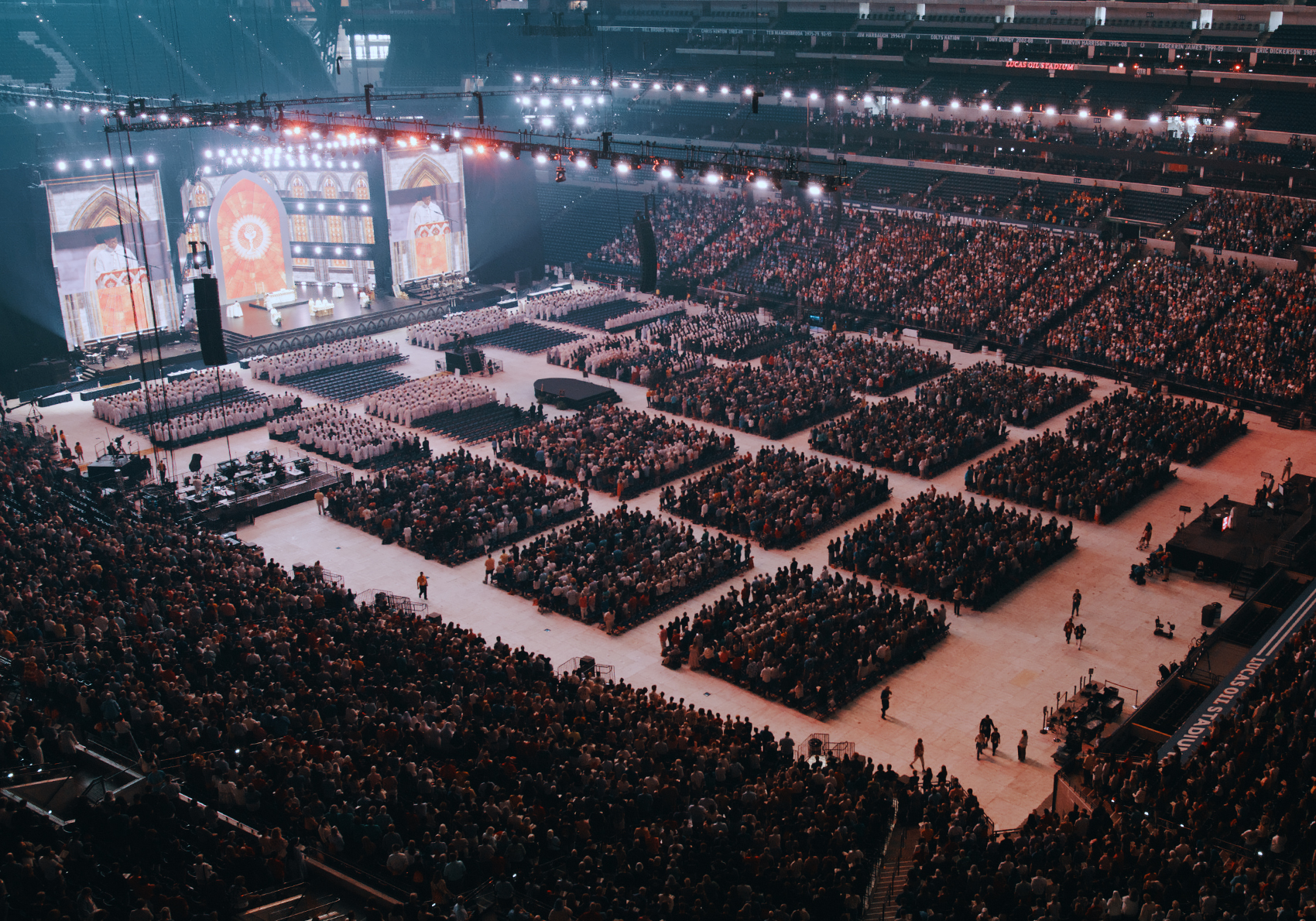
Executing a stadium-scale event takes more than gear, crew, and a strong run of show. It requires a production strategy capable of supporting main sessions, secondary environments, audience flow, broadcast needs, and the countless technical decisions that determine whether the event feels unified or fragmented.
Scale changes the entire approach
Once an event reaches stadium scale, production can no longer be treated as a collection of separate departments. It becomes a connected operational system. Main sessions, breakout environments, visual delivery, communications, and support infrastructure all have to work together under one clear direction. That reality was on full display at the National Eucharistic Congress in Indianapolis, where the week stretched across Lucas Oil Stadium, convention programming, public-facing moments, and livestream audiences at national scale.
Main sessions set the standard for everything else
Secondary rooms still shape the audience experience
Broadcast and livestream raise the technical stakes
Continuity matters more than coverage
One of the biggest misconceptions about large events is that success is defined by how much is covered. In reality, success is usually defined by continuity. The question is not whether each room has support. The question is whether the whole event feels connected from one environment to the next. At NEC, that meant supporting a week that included revival sessions in Lucas Oil Stadium, breakout sessions, an exhibit hall, large public processions, and remote participation through livestream.
Build one technical standard across environments
Keep communication centralized and disciplined
Treat every audience touchpoint as part of one experience
Preparation is what protects the event
At this level, preparation is not a luxury. It is the structure that protects the event once the schedule starts moving. The larger the footprint, the less room there is for reactive decision-making. Strong execution comes from pre-production that is detailed enough to anticipate pressure points before they become live problems. That includes systems planning, room readiness, visual alignment, broadcast coordination, staffing flow, and operational clarity across every team involved.
Execution has to serve the bigger goal
The most important lesson in stadium-scale production is that technical execution is never the end goal. It exists to support the purpose of the event. NEC was not simply large. It was historically significant for the Catholic Church in the United States, described as a milestone moment within the National Eucharistic Revival and the first National Eucharistic Congress in the U.S. in 83 years. That kind of event demands more than production coverage. It demands a partner who can carry the scale, protect the continuity, and help the full experience support what the event is meant to accomplish